How to Lower Your Handicap with Simulator Practice
Every golfer wants to lower their handicap, but more practice does not always mean better practice. If you have ever left the range unsure whether your session actually helped, you are not alone. Without clear feedback, it is easy to repeat the same mistakes and slow your progress. Golf simulator technology changes that!
With accurate ball flight data, swing analytics, and consistent practice conditions, a simulator experience helps you identify what is holding your game back, track improvement, and make adjustments that lead to lower scores on the course. Every session becomes measurable, focused, and more productive.
In this article, you will learn how a golf simulator practice in San Antonio can help lower your handicap faster, which metrics matter most, how to structure practice for better results, and why data-driven training is more effective than random range work. Whether your goal is to break 100, score more consistently in the 80s, or reach a single-digit handicap, this article will show you how to practice with purpose and improve with confidence.
Why Lowering Your Handicap Requires Better Practice, Not More Practice
Your handicap reflects how consistently you perform on the course, not just the occasional great shot. Lowering the handicap isn’t about hitting more golf balls, but more about making every practice session count.
The desire to improve has never been stronger. According to the National Golf Foundation, the U.S. golf instruction industry generates more than $1.5 billion annually, with golfers taking nearly 27 million lessons each year. Yet only about one in five golfers receives professional instruction, while most rely on self-guided practice through range sessions, videos, articles, and swing tips. This highlights a common challenge: many golfers are eager to improve but don’t always have access to structured feedback that helps them identify and correct their weaknesses.
Traditional range sessions often fall short because they provide little objective feedback. You might feel like you’re swinging better, but can you confidently answer questions like these?:
Did your swing path improve?
Was your clubface square?
Did your carry distance actually increase?
Were your misses becoming tighter?
Without objective feedback, these answers are mostly guesswork.
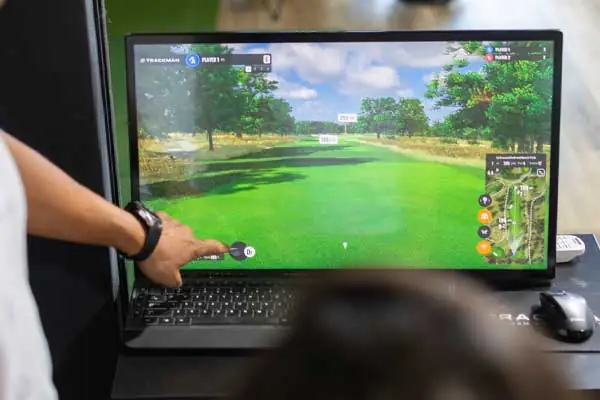
A golf simulator powered by Trackman removes that uncertainty by measuring every shot with precision. Instead of guessing whether you’re improving, you can track key performance metrics, monitor trends over time, and make data-driven adjustments that lead to more consistent play and, ultimately, a lower handicap.
The Data That Actually Lowers Handicap
1. Club Delivery Creates Consistency
Tracking clubhead speed, attack angle, club path, and face angle allows golfers to identify the underlying causes of inconsistent ball striking rather than simply reacting to poor shots.
For example, two slices may look identical in flight but originate from completely different swing mechanics. Accurate launch monitor data reveals the difference immediately.
2. Ball Flight Reveals Real Performance
Launch angle, spin rate, carry distance, apex height, and dispersion patterns provide objective evidence of whether swing changes are producing better results.
Instead of assuming a new swing thought is working, golfers can verify measurable improvement after every shot.
3. Dispersion Matters More Than Distance
Many golfers focus almost entirely on hitting the ball farther.
Yet strokes gained research consistently shows that reducing dispersion often contributes more to lower scores than adding extra distance because more shots finish in playable positions.
Practicing tighter shot patterns frequently produces faster handicap improvement than chasing maximum clubhead speed.
Golf Simulator in San Antonio Practice vs Traditional Driving Range
Practice Factor
Traditional Driving Range
Golf Simulator with Trackman
Ball flight measurement
Visual estimate
Precise launch monitor data
Distance accuracy
Often estimated
Measured carry and total distance
Shot dispersion tracking
Difficult
Every shot recorded
Swing analytics
Limited
Club path, face angle, attack angle, spin, launch and more
Progress tracking
Manual
Historical data comparison
Weather dependency
High
Climate-controlled environment
Course simulation
No
Thousands of virtual courses
Skill benchmarking
Limited
Data-driven improvement reports
Why Consistency Beats Perfect Swings
Many golfers search for swing perfection when they should be pursuing consistency. Lower handicaps in golf simulators in San Antonio come from eliminating costly mistakes rather than producing highlight-reel shots. Simulator practice encourages this mindset because every shot contributes to measurable performance trends over time rather than to isolated successes.
1. Smaller Misses Add Up
Improving average dispersion by even a few yards can result in more greens hit, fewer penalty strokes, and easier recovery shots throughout the round.
Those incremental gains often produce noticeable reductions in handicap over an entire season.
2. Distance Gapping Improves Club Selection
Many golfers unknowingly have inconsistent yardage gaps between clubs. Simulator sessions establish accurate carry distances for every club, helping players make smarter decisions during rounds and reducing costly approach-shot errors.
3. Repetition Builds Confidence
Because indoor practice removes weather, uneven lies, and changing range conditions, golfers can repeat the same shot multiple times while focusing entirely on execution and feedback. This consistency accelerates skill development.
How to Structure Simulator Practice for Faster Handicap Improvement
Simply booking a golf simulator in San Antonio is not enough. Improvement comes from practicing with clear objectives and measurable outcomes.
1. Start With a Baseline Assessment
The first session should establish current performance across every club. Recording carry distances, dispersion patterns, launch conditions, and club delivery metrics creates a benchmark for future comparison. Without a baseline, improvement becomes difficult to measure.
2. Practice One Variable at a Time
Changing grip, stance, takeaway, and tempo simultaneously make it impossible to know what caused improvement. Simulator feedback allows golfers to isolate a single adjustment while immediately measuring its impact. This creates faster learning with fewer bad habits.
3. Simulate Real On-Course Pressure
Instead of hitting fifty consecutive seven-irons, alternate clubs and targets just as you would during an actual round. This develops decision-making alongside swing mechanics and improves transfer to real-course performance.
4. Review Progress Regularly
Historical shot data reveals long-term trends that are impossible to detect from memory alone. Seeing measurable improvements in carry distance, dispersion, or launch consistency reinforces effective practice habits and highlights areas still needing attention.
Common Golf Simulator Practice Mistakes to Avoid to Lower Handicap
A golf simulator can accelerate improvement, but only if you use it strategically. Avoiding a few common mistakes can make every session more productive and help you see results faster.
1. Chasing Distance Instead of Consistency
It’s tempting to focus on increasing clubhead speed or hitting your longest drives. However, tighter dispersion, better contact, and predictable ball flight often have a greater impact on lowering your handicap than a few extra yards off the tee. Prioritize consistency first, then build speed as your mechanics improve.
2. Hitting Balls Without a Clear Goal
Mindlessly hitting shot after shot rarely leads to lasting improvement. Before each session, choose a specific objective: whether it’s improving carry distance with your irons, tightening shot dispersion, or refining your driver accuracy. Then, use the simulator’s data to measure your progress.
3. Ignoring the Performance Data
One of the biggest advantages of simulator practice is access to detailed analytics. Rather than focusing solely on where the ball finishes, review metrics such as club path, face angle, launch angle, spin rate, and carry distance to understand why each shot behaved the way it did.
4. Skipping On-Course Simulations
Perfecting the same shot repeatedly builds technique, but it doesn’t always prepare you for real rounds. Mix in virtual course play or randomize club selection to simulate on-course decision-making, helping you transfer your practice to better scoring when it matters most.
Frequently Asked Questions
1. Can a golf simulator really help lower your handicap?
Yes. A quality golf simulator equipped with launch monitor technology provides objective data on swing mechanics, ball flight, carry distance, spin, and dispersion. This allows golfers to identify weaknesses, practice with purpose, and measure improvement over time, making practice more effective than relying on feel alone.
2. How often should I practice on a golf simulator?
Consistency is more important than marathon sessions. Two to three focused simulator sessions per week, each with specific performance goals, generally produce better long-term improvement than occasional lengthy practices.
3. Is indoor golf practice as effective as outdoor practice?
Indoor practice is highly effective for developing swing mechanics, improving distance control, and tracking performance metrics. Combining simulator practice with regular on-course play provides the best overall improvement because players can refine mechanics indoors and apply them in real playing conditions.
4. What Trackman data is most useful for lowering a handicap?
Golfers should focus on club path, face angle, carry distance, launch angle, spin rate, smash factor, and shot dispersion. Together, these metrics help improve consistency, optimize ball flight, and support better club selection on the course.
Lower Handicap with a Golf Simulator in San Antonio
At Fairway SA, golfers have 24/7 access to Trackman-powered simulator bays that transform practice into a data-driven improvement process. Instead of guessing what needs work, you’ll receive precise instructions and analytics on swing mechanics, ball flight, club delivery, carry distances, and shot dispersion in a climate-controlled environment built for year-round performance.
Whether you’re looking for a golf simulator in San Antonio to fine-tune your swing or a year-round practice facility to help you reach your next handicap goal, Fairway SA combines Trackman technology, 24/7 access, and a performance-focused environment to help you improve with confidence.
Foresight vs Trackman: Launch Monitor Comparison for 2026
If you’ve spent any time researching golf simulators, you’ve run into these two names again and again: Foresight and Trackman. Both companies build the launch monitors that power the world...
Best Time to Book Indoor Golf: Peak Hours, Pricing & Pro Tips
Indoor golf has exploded over the last few years, and if you’ve recently tried to grab a bay on a Friday evening, you’ve likely noticed. More golfers are choosing simulators over waiting o...
How to Lower Your Handicap with Simulator Practice
Every golfer wants to lower their handicap, but more practice does not always mean better practice. If you have ever left the range unsure whether your session actually helped, you are not alone. With...